
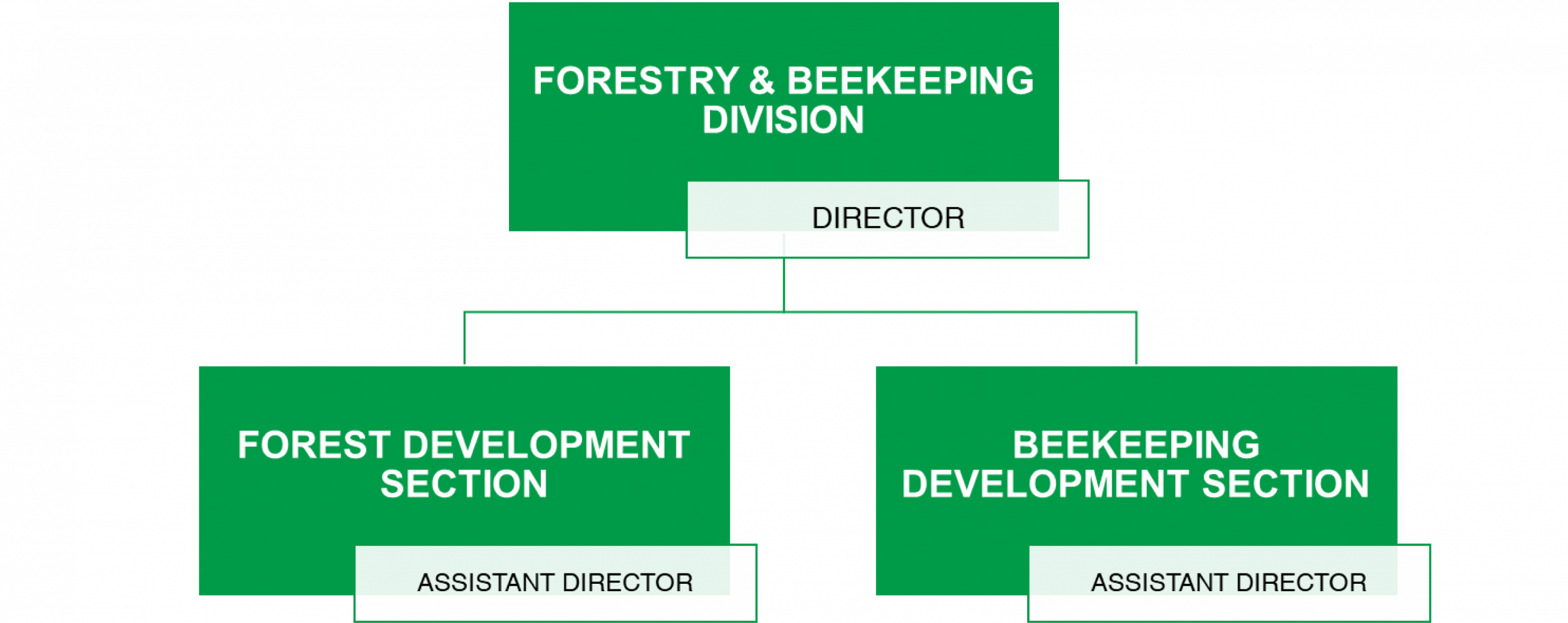
The division objective is to develop, implement and monitor mechanisms for sustainable conservation and management of forest and bee resources and services in the Country.
Led by a Director
Forestry and Beekeeping Division – FBD is one of the divisions under Ministry of Natural Resources and Tourism which is purposely for regulating two sectors being Forest Sector and Beekeeping Sector in the country. The division was formed in 1985 after the combination of Beekeeping Department and Forestry Department due to government restructuring and cost reduction exercise.
The whole process of transformation was geared towards improving the efficiency and effectiveness of the management and administration of the forestry and Beekeeping sectors which have all culminate to the formation of Tanzania Forest Services Agency (TFS) in 2010. The main role of TFS is to manage national forest and bee resources in a sustainable manner by ensuring sustainable supply of various forest and bee products and services, stable ecosystem and maintaining biological diversity
Forestry and Beekeeping division is guided by the National Forest and Beekeeping Policies adopted in March 1998, whose overall goals are to enhance the contribution of the forest and beekeeping sector to the sustainable development of Tanzania and the conservation and management of her natural resources for the benefit of present and future generations.
Implementation of the Forest and Beekeeping Policies is done using National Forest Policy Implementation Strategy and National Beekeeping Policy Implementation Strategy ten-year frameworks (2021 – 2031), The Forest Act of 2002 (Cap. 323) and Beekeeping Act of 2002 (Cap. 224) together with its guidelines provide legal framework for the management of forests and bee resources.
Policy, Act, Subsidiary legislations and guidelines are implemented by Institutions under the Division which are; Tanzania Forest Service Agency –TFS and Tanzania Forest Fund – TaFF.
In implementing the Forest and Beekeeping policies, the Division collaborate with training and Research Institutions within and outside the Ministry. Institutions within the Ministry includes:
and outside the Ministry includes
Policy, Act, Subsidiary legislations and guidelines are implemented by Institutions under the Division which are;
Led by an Assistant Director
Current Status
NAFORMA report shows that the forest land area is about 48.1 million ha in Tanzania Mainland. It also shows the extent of distribution by forest types and ownership, whereby Woodlands cover 44.6 million ha (93%) of the forestland while catchment forests; mangroves, coastal forests and government forest plantations occupy 3.4 million ha (7%).
The existing forest tenure arrangements are under central government (34.5%), local government (6.5%) and village governments (45.7%), private (7.3%) and unreserved forests (6.0%). The highest percentage of forestland is owned and managed by village governments. However, 19.67 million ha (89.8%) of forests in village lands is unreserved (open access forest areas) and is subjected to unsustainable practices such as agricultural expansion, wild fires, livestock grazing and illegal harvesting.
The Government introduced Participatory Forest Management (PFM) that is being promoted all over the country to improve management of forest resources. There are two approaches to PFM. These are Joint Forest Management (JFM) and Community-Based Forest Management (CBFM). JFM takes place on reserved land owned and managed by either the government (central or local) or private sector. In this approach, forest- adjacent communities enter into joint management agreements to share responsibilities, costs and benefits with the owner. CBFM takes place on forests in village lands and reserved forests from general lands. In this arrangement, the local communities have full mandates to own and manage forests.
Develop, review, monitor and evaluate implementation of National Forest Policy legislations, strategies and standards;
Develop, review and disseminate forestry extension services guidelines and monitor its implementation in liaise with Ministry responsible for Regional Administration and Local Government;
Provide technical advice, guideline and standards on carrying out environmental impact assessment for all investments in the forestry sector and monitor their implementation;
Coordinate and guide research undertaken by various institutions and organisations on the identified research priority areas in forestry;
Establish guidelines and procedures for collection, analysis, storage and retrieval of forest resources data;
Prepare guidelines, coordinate and facilitate establishment and management of Forest Reserves;
Provide guidance in formation of groups involved in forest management and conservation; and
Customise, provide advice and coordinate/facilitate implementation of forestry development and management conventions and treaties.
Led by an Assistant Director
Current Status
Beekeeping in Tanzania plays a major role in socio-economic development. It is an important source of income especially for communities living close to forests and woodland. The country produces about 33,861 tons of honey and 1,913 tons of beeswax per year. This production is below the potential capacity of producing 138,000 tons of honey and 9,200 tons of beeswax per annum from the wealth of 9.2 million honeybee colonies. The beekeeping sector generates about US$ 2 million from export of honey and beeswax and employs more than 2 million people.
Beekeeping is practiced all over Tanzania, with large production observed in the Miombo woodlands of southern highlands, central, western and northern zones. Potential beekeeping regions where bee products are harvested in large quantities are in the central and western part of the country. Key production regions include Tabora, Kigoma, Katavi, Singida, Geita and Shinyanga. Other regions with high potential include Iringa, Mbeya, Ruvuma, Lindi and Mtwara.
Each section is divided into four desks namely: